Glide Through the French Countryside on Canal du Midi in 2026
6 September 2026
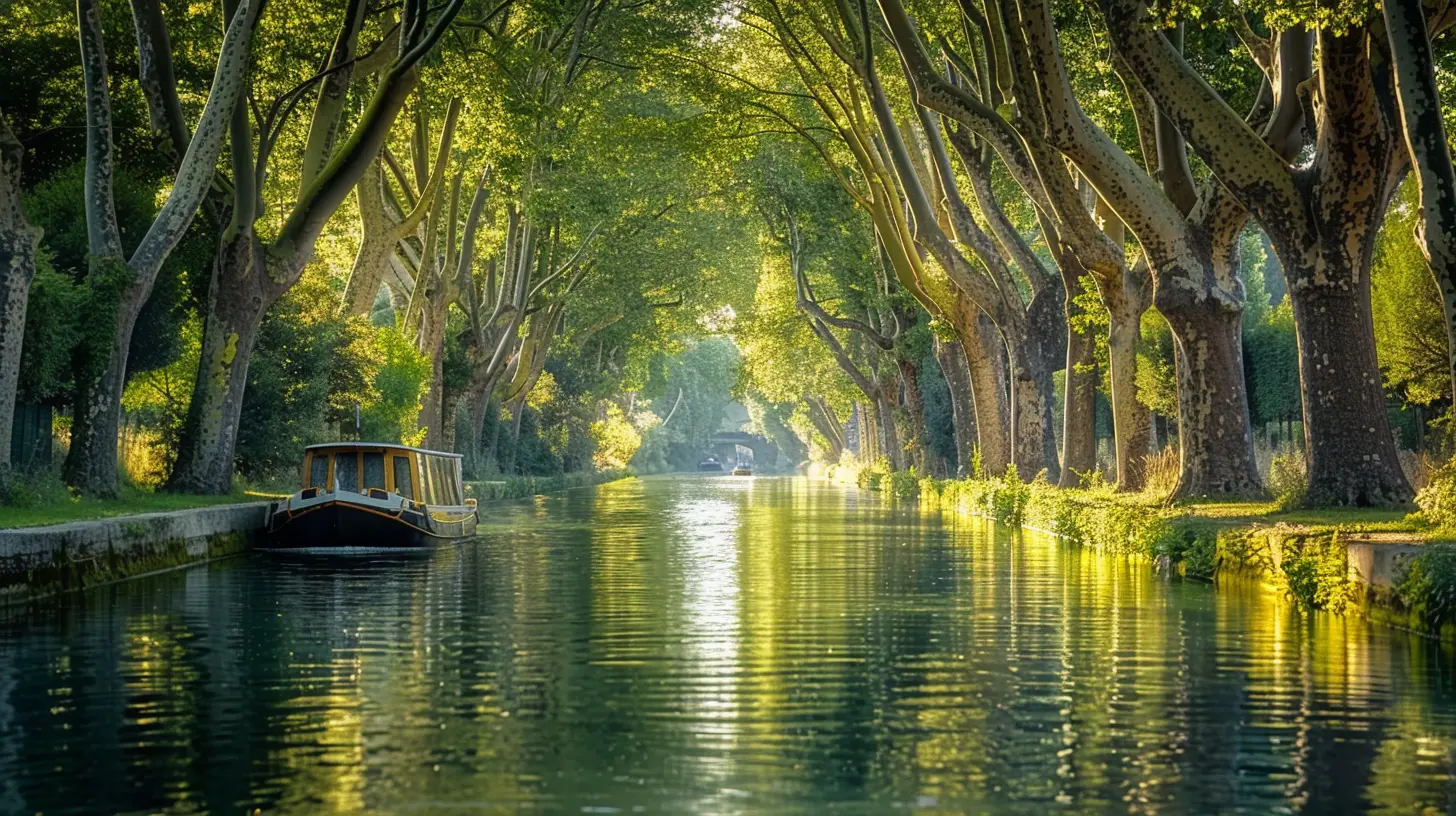
There is a particular kind of silence that settles over a canal barge at dawn. The water barely whispers against the hull, and the only other sound is the occasional pop of a bubble rising from the muddy bottom. If you wake early enough, you will see the plane trees lining the banks casting long, crooked shadows across the water, and you will understand why this waterway, built centuries before the automobile, still offers one of the most profound ways to move through France.
The Canal du Midi is not a river. It is a carefully engineered ribbon of calm that connects the Atlantic to the Mediterranean, winding for 240 kilometers from Toulouse down to the lagoon city of Sète. In 2026, the canal will celebrate another season of slow travel, and if you have ever considered renting a boat and steering your own holiday through vineyards, sunflower fields, and medieval villages, this is the year to do it properly.
But let us be clear about something from the start. This is not a lazy vacation. It is an active, thinking person's holiday disguised as indolence. You will do more planning, more problem solving, and more physical work than you might expect. And that is exactly why it stays with you long after you return home.
Why the Canal Still Matters in an Age of Instant Travel
The appeal of the Canal du Midi in 2026 is not about efficiency. It is about the deliberate rejection of it. A plane from Paris to Barcelona takes less than two hours. A train from Toulouse to Carcassonne takes forty minutes. A barge takes four to six hours to cover the same distance, and you will stop for locks, for lunch, for a swim, and for no reason at all except that the light on the water looks too good to leave behind.This canal was never meant for speed. It was built in the seventeenth century to carry goods, wine, and wheat between the two seas, saving ships from the long voyage around Spain and the threat of pirates. The engineer Pierre-Paul Riquet conceived it as a commercial artery, but its legacy has become something entirely different. Today it carries travelers, not cargo, and its value lies not in what it transports but in what it allows you to notice.
What you notice, mostly, is time. Time passes differently when your top speed is six kilometers per hour. You notice the way the wind changes direction as you pass through a grove of cypress trees. You notice the color of the water shift from green to brown to silver depending on the depth and the sky. You notice that the man fishing from the bank has been there for three hours and has caught nothing, and you find this strangely comforting.
The canal also matters because it is a living piece of history. The locks, the bridges, the stonework, and the famous plane trees all date back to a period when engineering was done by hand and by eye. When you pass through a lock that has been operating since 1681, you are participating in a ritual that thousands of bargemen have performed before you. The mechanism may be modernized, but the geography is unchanged.
Choosing Your Vessel: The Right Boat for the Right Journey
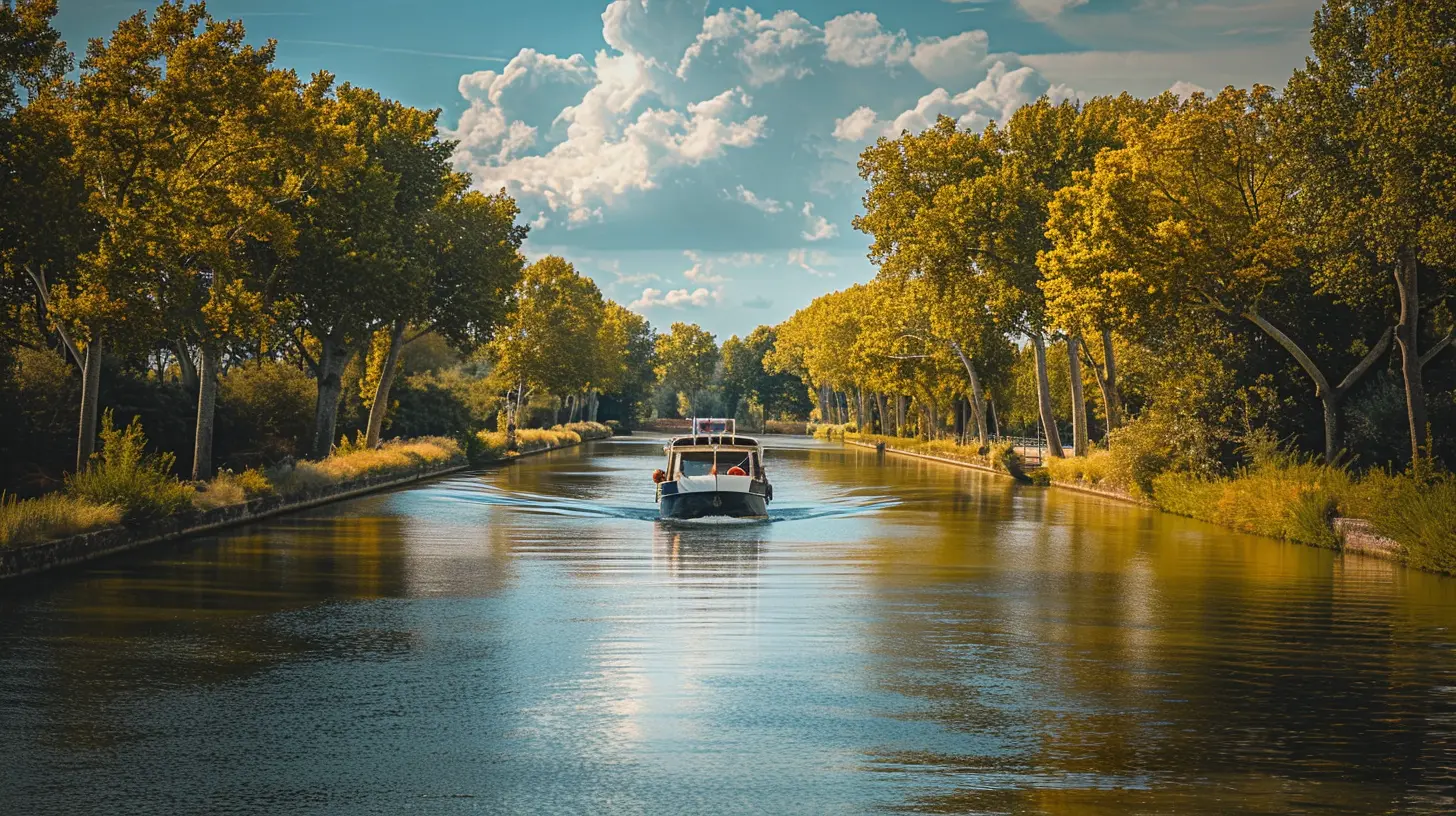
The single biggest decision you will make is not where to go but what to float on. The canal is served by several rental companies, primarily based in the ports of Homps, Argens-Minervois, Le Somail, and Castelnaudary. The boats range from compact two-person penichettes to spacious luxury barges that sleep eight or more with air conditioning, multiple bathrooms, and a sun deck that could host a small dinner party.For a first-time canal traveler, a boat in the ten to twelve meter range is the sweet spot. These boats are narrow enough to navigate the locks with relative ease, yet wide enough to feel stable when a passing cruiser creates a wake. They typically have a forward deck with a table and chairs, a small but functional kitchen, a shower and toilet, and one or two cabin areas. You do not need sailing experience. The boats are designed for people who have never steered anything larger than a rowboat.
The steering is done from a top deck, usually with a simple helm that controls the engine and a rudder. You will stand, exposed to the weather, looking forward over the bow. This is a key point that many people misunderstand. You are not sitting inside a cabin like a car. You are standing outside, in the sun, the wind, and occasionally the rain, watching the canal unfold in front of you.
Larger boats offer more comfort but also more complexity. The bigger the boat, the more carefully you must approach locks, bridges, and mooring points. A twelve meter boat can be handled by two people with moderate fitness. A fifteen meter boat requires more coordination and a better understanding of how the wind and current will push you around. For a first trip, err on the side of smaller. You will thank yourself when you try to moor against a stone wall in a gusty crosswind.
The Rhythm of the Locks: Mastering the Art of Patience
The locks are the heart of the Canal du Midi experience, and they are also the source of most anxiety for first-time boaters. There are sixty-three locks between Toulouse and the Mediterranean, each one a stone chamber that raises or lowers your boat by several meters. Some are single locks. Others are staircase locks, where several chambers are connected without intermediate gates, and you move through them in sequence without stopping.Here is the thing about locks. They are not difficult, but they are unforgiving of haste. You approach a lock slowly, usually at idle speed, and you wait for the lock keeper or the automated system to open the gates. You motor in, tie your lines to the bollards on the wall, and wait for the water to rise or fall. The water moves slowly. It can take ten to fifteen minutes to fill or empty a large chamber. During that time, you have nothing to do but watch the stone walls slide past and chat with your crew.
The common mistake is to tie your lines too tightly. The boat will rise and fall several meters, and if your lines are fixed at a single point without slack, you will either snap the rope or pull the bollard out of the wall. The correct technique is to wrap the line around the bollard once and hold the free end in your hand, allowing it to slip as the boat moves. This takes a bit of practice, but after two or three locks, you will do it without thinking.
Another mistake is to rush the approach. The propeller of a canal boat is at the rear, and the steering is at the front. This means the boat does not turn like a car. It pivots around its center, and the stern swings wide. If you approach a lock at an angle, you will hit the wall. The solution is to approach very slowly, at a near stop, and use short bursts of power to correct your course. Patience is not just a virtue here. It is a survival skill.
The Route: From Toulouse to the Sea
You can join the canal at any point, but most rental bases are concentrated in the middle section, between Carcassonne and Béziers, where the landscape is most beautiful and the locks are most frequent. This is the Minervois wine region, a rolling patchwork of vineyards, olive groves, and stone villages that cling to the hillsides.A classic week-long itinerary starts in Homps or Argens-Minervois and heads east toward the Mediterranean. On the first day, you will travel only a few hours to Le Somail, a tiny hamlet that exists almost entirely because of the canal. There is a circular stone bridge, an old chapel, and a bookshop that sells used paperbacks from a converted barge. You can moor for free along the bank, and the evening will be quiet except for the ducks and the occasional cyclist passing on the towpath.
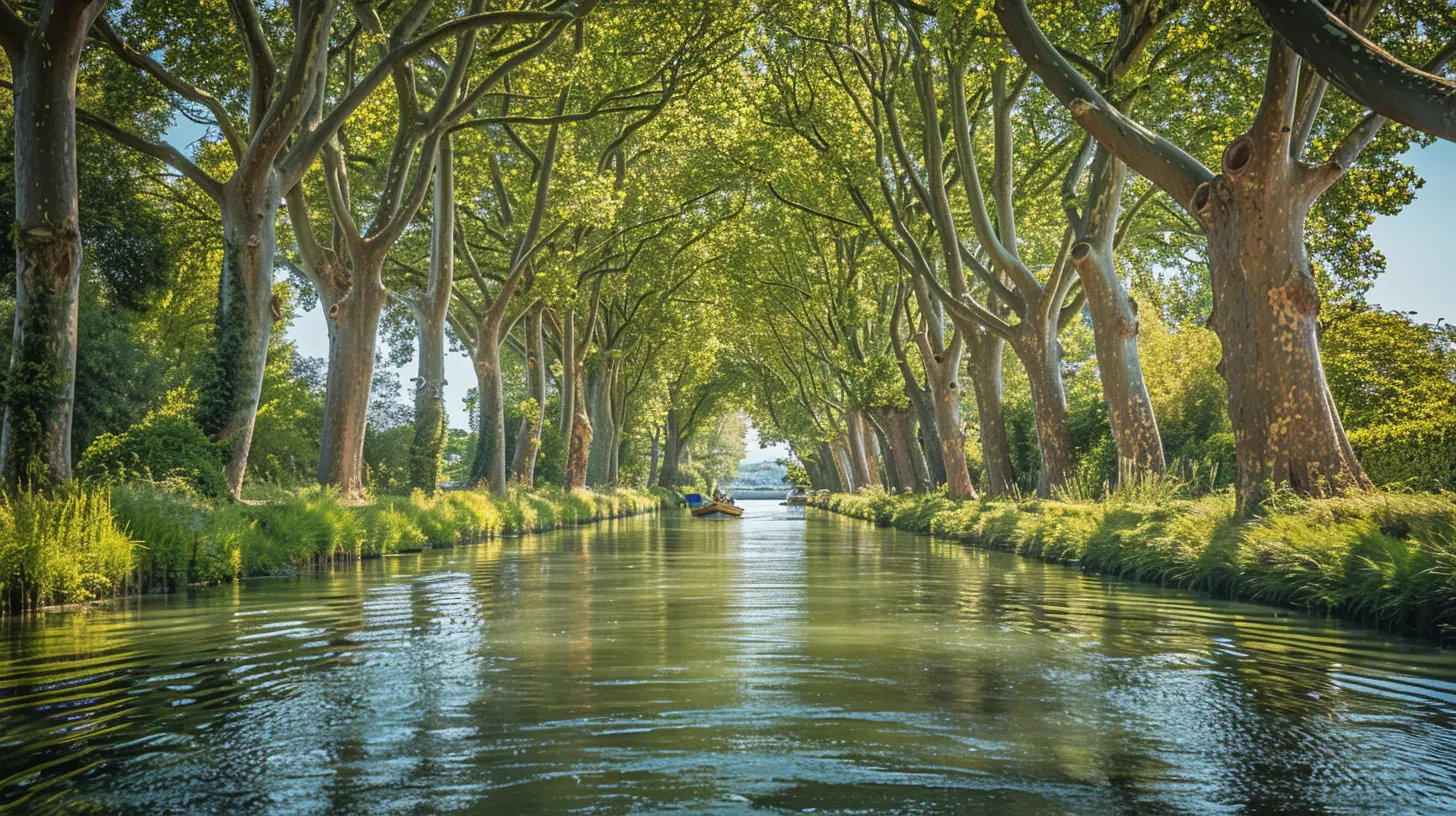
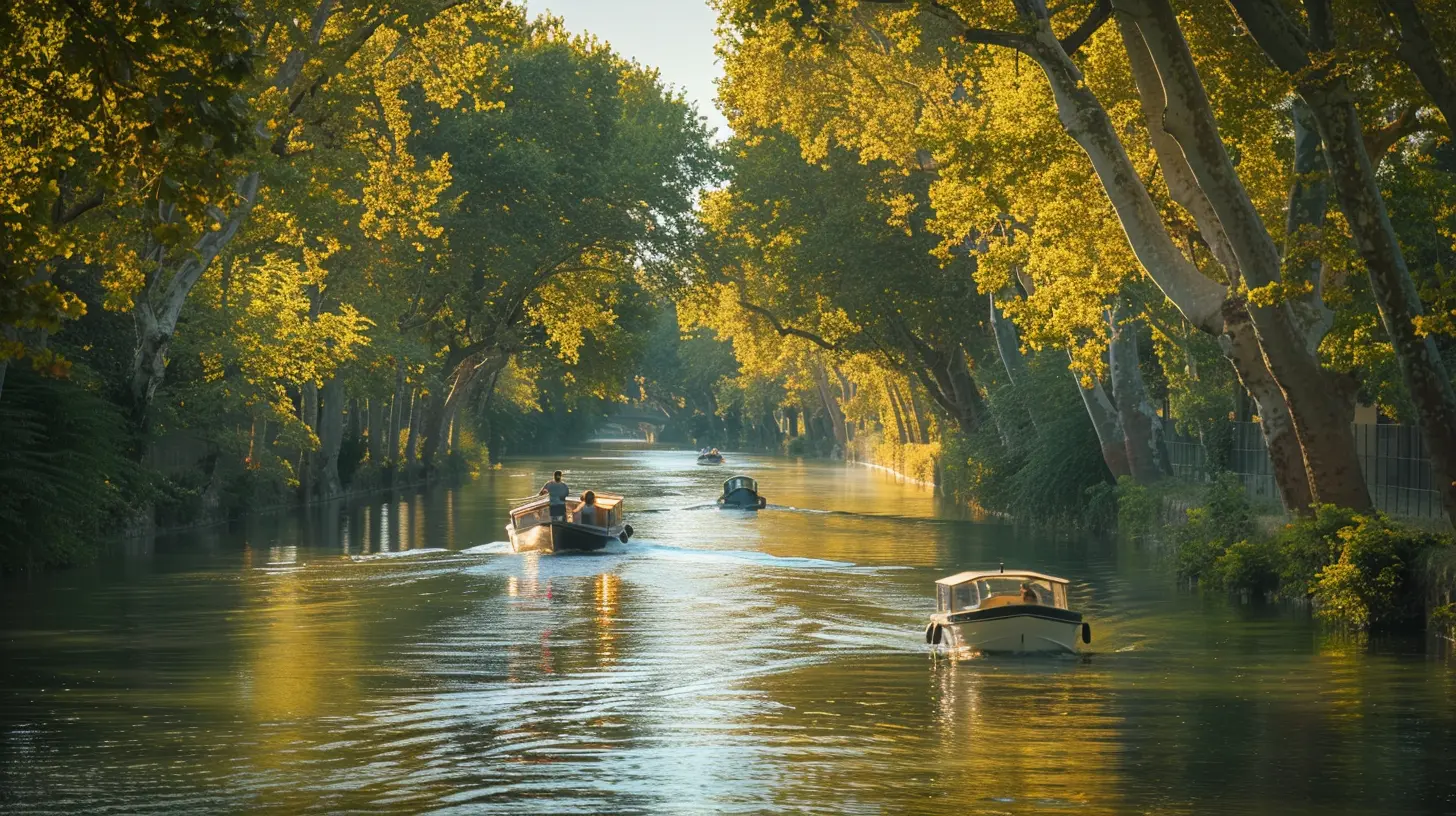
The next day, you push on toward Capestang, passing through the long, straight sections where the canal cuts through the plain. This is where you will see the plane trees at their most majestic. These trees were planted two hundred years ago to stabilize the banks and provide shade for the horses that pulled the barges. They now form a continuous canopy, a green tunnel that filters the sunlight into a dappled, golden glow. The canal is famous for these trees, but it is also fighting a losing battle against a fungal disease called canker stain. Many trees have been felled and replaced with younger ones. The character of the canal is slowly changing, and seeing the old trees now, before they are gone, is a reason to go soon.
From Capestang, you descend through a series of locks toward Béziers, where the canal crosses the Orb River on a massive stone aqueduct. This is one of the engineering marvels of the waterway, and you will pass over it without fully appreciating the scale unless you stop and walk back to see the arches below. Beyond Béziers, the canal climbs through the Fonserannes staircase, a spectacular flight of seven locks that raises the water level by over twenty meters. This is the most photographed section of the canal, and for good reason. It is also the most demanding. The locks are operated by a team of keepers, and you will wait your turn among a queue of other boats. It is a social experience, a floating traffic jam where you exchange pleasantries with strangers from Germany, Holland, and Australia while the water does its slow work.
The Practicalities of Life on Board
Living on a canal boat is not like living in a hotel. The cabins are compact, the ceilings are low, and the water tanks are finite. You will need to manage your electricity, your fresh water, and your waste. Most boats have solar panels that keep the batteries charged, but if you run the heating or the air conditioning all night, you will drain them. The rule is simple. Use what you need, but conserve what you can.Cooking on board is a delight. The kitchens are small but well equipped, and the local markets provide everything you need for a simple meal. In the mornings, you can walk to a village bakery for fresh baguettes and croissants. In the evenings, you can grill sausages on the deck and eat with a bottle of local Minervois wine while the sun goes down over the vines.
Mooring is mostly free. You can tie up almost anywhere along the bank, provided you do not block a lock, a bridge, or a water point. The best spots are the ones with a little shade and a view. You will learn to read the bank. A steep stone edge means easy access. A muddy slope means you will be climbing through reeds. A spot under the plane trees is perfect until the wind picks up and the branches start dropping twigs and leaves on your deck.
One of the most common misconceptions is that you need to book your mooring in advance. You do not. This is not the French Riviera. There are no marina fees for the most part, and the canal is long enough that you will always find a place to stop. The only exception is during the peak summer weeks of July and August, when the popular villages can get crowded. If you want a prime spot in Le Somail or at the foot of the Fonserannes locks, arrive early in the afternoon.
The Weather and the Seasons: When to Go in 2026
The canal season runs from early April to late October. The rental companies close during the winter, partly because the weather is unreliable and partly because the canal undergoes maintenance. The best time to go is May or September. In May, the countryside is lush and green, the temperatures are mild, and the crowds are thin. In September, the summer heat has passed, the vineyards are heavy with grapes, and the harvest festivals are beginning.July and August are the most popular months, and they are also the most challenging. The temperatures can exceed thirty-five degrees Celsius, and the plane trees provide shade but also trap the heat. The locks are busier, and you will spend more time waiting. The water level can drop, making some sections shallower and requiring more careful navigation. If you have flexibility, avoid the peak summer season. The canal is a place for lingering, not for queuing.
The weather in the Languedoc region is generally dry and sunny, but sudden storms can appear in the afternoon, especially in the spring and autumn. These storms are brief but intense, with strong winds and heavy rain. If you are caught in one, the best strategy is to find a sheltered mooring and wait it out. The boats are sturdy, and the canal is protected by its banks, but a sudden gust can push you sideways into a tree or a bridge. Always check the forecast in the morning and plan your day around any potential weather systems.
What Most People Get Wrong: The Misconceptions
There are several persistent myths about canal boating that need to be addressed. The first is that it is an easy holiday requiring no skill. This is false. It requires constant attention, especially when navigating locks, bridges, and mooring. The second is that it is boring. This is also false, but it depends on your temperament. If you need constant stimulation, a canal boat will drive you mad. If you can sit for an hour watching a heron fish from the bank, you will find it mesmerizing.The third misconception is that you need to be physically fit. You do not need to be an athlete, but you do need to be mobile. You will be climbing on and off the boat, handling ropes, and walking along the towpath to operate lock gates. Some locks are automated, but many still require manual operation. You will turn heavy iron wheels and push wooden beams. If you have limited mobility, you can still enjoy the canal, but you should choose a route with fewer locks or hire a skipper.
A fourth misconception is that the canal is a single, uniform waterway. It is not. The section between Toulouse and Castelnaudary is wide, straight, and relatively easy. The section between Béziers and the Mediterranean is more industrial, with larger locks and more commercial traffic. The most scenic and varied section is the middle stretch, from Carcassonne to Béziers, where the canal winds through the foothills of the Montagne Noire and the vineyards of the Minervois.
The Cultural Context: More Than Just Water
The Canal du Midi is not just an engineering feat. It is a cultural landscape, recognized by UNESCO as a World Heritage Site since 1996. The villages along its banks are not tourist attractions in the conventional sense. They are working communities that have adapted to the presence of the canal. In Le Somail, you will find a tiny chapel and a hat museum. In Capestang, you will find a Gothic church that was never completed. In Poilhes, you will find a small harbor where the locals gather in the evening to play pétanque.The food of the region is robust and earthy. Cassoulet, the famous bean and meat stew, originates from Castelnaudary, and you should try it there, in a restaurant that has been serving it for generations. The wines are equally distinctive. The Minervois produces reds that are dark and tannic, perfect with grilled meats. The whites are fresh and citrusy, ideal for drinking on the deck at sunset. Do not be afraid to ask the local winemakers for recommendations. They are proud of their product and happy to share it.
The canal also has a rich literary and artistic history. The poet Frédéric Mistral wrote about the region, and the painter Jean-Auguste-Dominique Ingres was born in Montauban, not far from the canal's western end. The towpath, which was once walked by horses pulling barges, is now a popular cycling and walking route. You will share it with joggers, families, and long-distance cyclists following the Canal du Midi as part of the larger EuroVelo 8 route that runs from the Atlantic to the Mediterranean.
Planning Your 2026 Trip: A Step-by-Step Approach
Start by deciding how many days you have. The minimum for a meaningful trip is four days. A week is ideal. Two weeks will allow you to cover the entire canal from Toulouse to the sea, but you will need to keep a steady pace to do so. Most rental companies offer one-way trips, where you pick up the boat in one location and return it to another. This adds a logistical layer, but it also allows you to cover more ground without retracing your route.Book your boat well in advance, especially if you want a specific model or a weekend departure. The rental companies release their availability about a year ahead, and the popular boats for the summer months go quickly. If you are flexible with your dates, you can often find last-minute deals in the spring or autumn.
Before you arrive, familiarize yourself with the basic rules of the canal. The speed limit is six kilometers per hour, and you must give way to commercial barges and to boats coming from the right at intersections. You must also yield to sailboats, although you will rarely encounter them. The canal is narrow, and passing another boat requires a bit of coordination. Reduce your speed and keep to the right. The wash from your boat can damage the banks, so always be mindful of your wake.
When you arrive at the rental base, you will receive a thorough briefing. This will cover the operation of the boat, the navigation rules, and the location of the locks and water points. Pay attention. The briefing is not just a formality. It contains the information you will need to avoid the most common problems.
The Intangible Reward: What You Bring Home
The Canal du Midi is not a destination you can check off a list. It is an experience that changes your sense of time and place. When you return home, you will find that you look at maps differently. You will understand why the Romans built straight roads and why the French built canals that meander through the countryside, following the contours of the land rather than fighting against them.You will also find that you have a new appreciation for silence. The hum of the engine, the lap of the water, the call of a cuckoo from the trees. These sounds become your companions, and when they are gone, you will miss them. The canal teaches you that movement does not always mean progress, and that the best way to see a country is often the slowest way.
In 2026, the Canal du Midi will still be there, its waters still flowing from the hills to the sea. The plane trees will still cast their shadows, and the locks will still rise and fall with the patient rhythm of a machine that has been working for over three centuries. Whether you are a first-time boater or a seasoned canal traveler, the water will welcome you. All you have to do is step aboard, cast off the lines, and let the current guide you through the heart of the French countryside.
all images in this post were generated using AI tools
Category:
Iconic RoutesAuthor:

Reed McFadden
Discussion
rate this article
2 comments
Sylas Sharp
Exploring Canal du Midi in 2026 promises unforgettable beauty and peaceful adventures!
October 8, 2026 at 4:27 AM
Odessa McVey
Exploring the Canal du Midi sounds like a perfect way to experience the beauty of the French countryside. Can't wait!
September 10, 2026 at 2:46 AM
Reed McFadden
I agree! The Canal du Midi offers a unique perspective on the stunning landscapes. Exciting times ahead!